A New Tool Enters Exterior Cleaning in Manitoba
by Kelly Smith
We’ve all seen it: Window cleaners in harnesses and helmets, suspended hundreds of feet in the air, doing a job most of us are quietly grateful we don’t have to do.
At last year’s Building Conference, property managers and building owners were introduced to a new way of accomplishing that same high-risk task.
Beginning this spring, mosquitos and birds won’t be the only things flying around Winnipeg high-rises. Bee-Clean Building Maintenance is preparing to deploy Manitoba’s first exterior building cleaning drone, a tool that shifts how exterior maintenance might be planned in the years ahead. “This removes people from situations where one small error can have serious consequences,” says Juan Carcamo, Manager of Special Projects for Bee-Clean.
“For years, window cleaning meant guys harnessed up, hanging from the roof, working at heights,” says Carcamo. Rope access, lifts, and suspended crews have long been the standard approach for exterior building cleaning. “We’ve accepted that level of risk because there weren’t many alternatives.”
After years of contracting out exterior window cleaning, Bee-Clean acquired a dedicated window cleaning business in 2025, allowing the Winnipeg-based cleaning company to bring that work in-house. The decision to invest in both traditional capabilities and drone technology has ensured that Bee-Clean can offer the full range of solutions rather than relying on only the traditional approach.
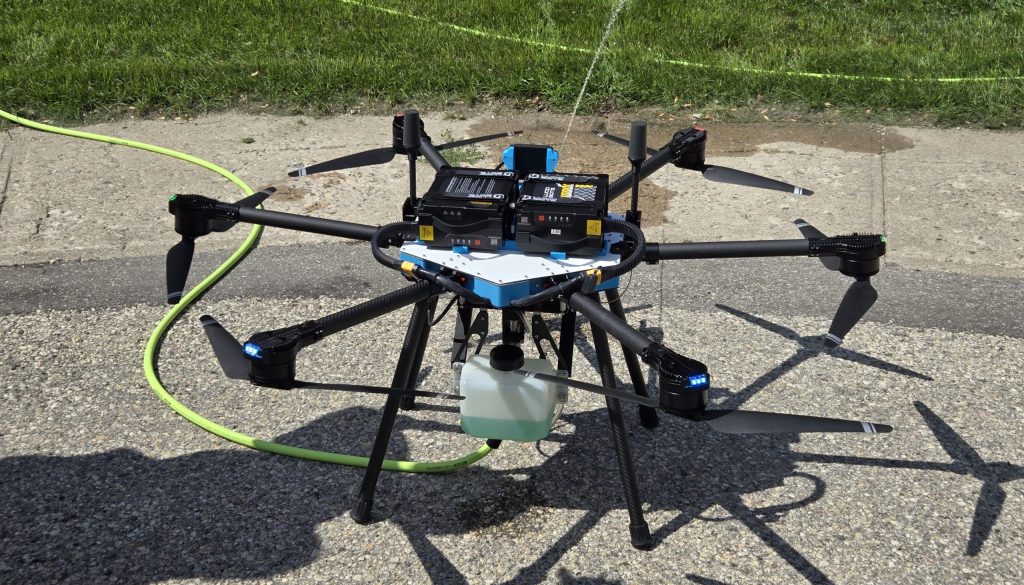
It’s not just a window cleaning drone; it’s an exterior cleaning drone. Even better than windows, it’s ideal to clean facades.
Antonio Gonzalez, Director of Operations
Bee-Clean Building Maintenance
Introduction to Manitoba’s Building Industry
For many BOMA members, The Building Conference’s 2025 tradeshow marked their first exposure to drone-assisted exterior cleaning.
“There was no one here that had it, and we wanted to be the first ones in Manitoba,” recalls Raquel Neves, Business Development Manager at Bee-Clean. “And the best way to display the new technology was at The Building Conference. It got a lot of attention. People stopped because they’d never seen a drone that big doing that kind of work.”
What began as a visual tradeshow demonstration quickly turned into a practical discussion for many, with attendees inquiring about building suitability, operating limits, and where the technology might realistically fit.
“It’s not just a window cleaning drone; it’s an exterior cleaning drone,” says Antonio Gonzalez, Bee-Clean’s Director of Operations. “Even better than windows, it’s ideal to clean facades.” Roofs and solar panels are also well-suited for the drone. “We don’t have many solar panels here yet, but before 2030 we’ll have quite a few more,” Gonzalez explains.

From the Ground Up: How the System Operates
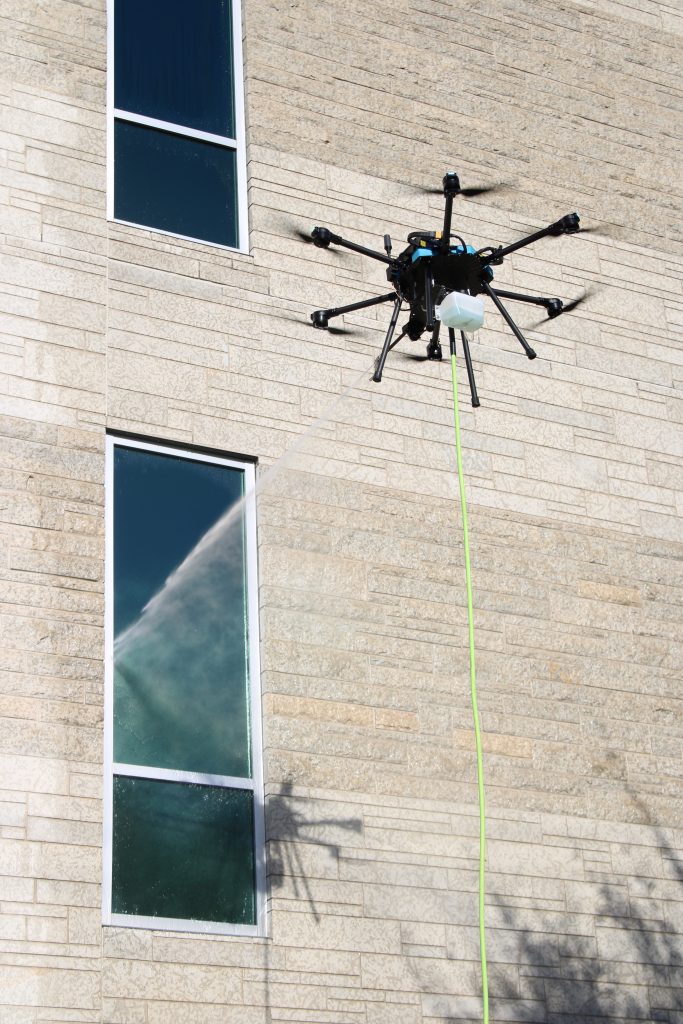
In practice, drone-assisted exterior cleaning is a controlled, ground-based operation. The system is operated by a two-person crew, with one team member piloting the drone and the other acting as a safety observer who manages battery charging and rapid swaps. “The operator controls everything from the ground and sees it live on the screen,” explains Carcamo.
“It’s connected to the building’s water supply, so we’re not carrying water in the air,” adds Gonzalez. Battery changes are planned into the workflow to maintain continuity. “Each flight is about half an hour, so we rotate batteries and keep going.”
For most properties, Bee-Clean recommends exterior window cleaning twice per year as part of a regular maintenance cycle, typically in the spring and fall. In case of extreme buildup or post-construction debris, a traditional (manual) cleaning can be the better first step). “For the initial clean after construction – if the windows are really bad – we actually recommend doing it (the traditional way) first, then continuing maintenance with the drone,” advises Carcamo.
You need a pilot license to operate it. It’s not something anyone can just pick up and use.
Juan Carcamo, Special Projects Manager
Bee-Clean Building Maintenance
Of course, weather can prove problematic. Both drone-assisted and traditional exterior cleaning must pause in high wind situations, and stop entirely once winter conditions set in. “You can’t operate in extreme wind,” Carcamo states. “And once we get snow on the roof of the building, it’s over for the season.”
Before any flight, authorization is required from NAV Canada, notes Carcamo, reinforcing the fact that the drone operation adheres to established aviation and safety protocols.
Behind the Controls: Licensing, Airspace, Oversight
While the drone work may look simple to run, its use is governed by clear regulatory requirements. “You need a pilot license to operate it. It’s not something anyone can just pick up and use,” says Carcamo. Currently, two Bee-Clean employees hold their basic pilot license and are operating the system under those credentials.
The team is also preparing for what they see coming next. According to Carcamo, the company already has its basic license and is working toward an advanced one. He believes that advanced certification is expected to be the ‘baseline’ requirement in future.
“This isn’t recreational drone use – it’s regulated equipment. I would like to have all my guys set up with licenses and certifications so they can use the drone,” Carcamo said, which would support Bee-Clean’s goal of adding more drones to its arsenal in future.
Not Every Building is a Fit
Drone cleaning is not suitable for every site. Feasibility depends on a combination of physical, regulatory, and environmental factors that must be evaluated on a case-by- case basis. “There are rules about where you can fly
and where you can’t,” explains Gonzalez.
Airspace restrictions are one of the first considerations. Drone operation is not permitted within approximately
six kilometres of an airport or within roughly two kilometres of hospitals with active heliports to ensure there is
no interference with airspace activity.
Building height is another factor. “The safe operating height right now is about one hundred feet,” says Gonzalez.
That limitation is tied in part to the system’s hose-fed design. “The hose has added weight because it’s carrying water.” In some cases, platforms may be used to extend hose reach, but doing so introduces additional logistical and planning considerations.
Site conditions at ground level also matter. Operating over roadways requires planning and often permits, which increases the cost. “You can’t fly over traffic unless the street is blocked and permitted,” says Gonzalez.
The potential of drone technology is intriguing to us—not only from an innovation standpoint, but also from a practical one.
Christina Pimentel, Property Manager
Globe Property Management
From Member Curiosity to Consideration
After seeing the technology at the conference last fall, several BOMA members expressed interest in learning whether it could work for their buildings.
“We have a couple of buildings in our portfolio where we could potentially use this technology, and it would reduce the maintenance time required,” says Christina Hazzard, Commercial Property Manager at Shelter Canadian Properties.
“It would also be less invasive for some of the tenants because they don’t always like having the guys (window washers) right there,” she continued.
For Christina Pimentel, Property Manager with Globe Property Management, the interest was tied to challenges pertaining to building access. “At Uptown Lofts, for example, there are windows that sit above a marquee that are extremely difficult to access without the use of a lift,” notes Pimentel, adding that the situation has made routine maintenance “complex and costly.”
“The potential of drone technology is intriguing to us—not only from an innovation standpoint, but also from a practical one,” explains Pimentel. If it proves efficient and cost-effective, it could allow companies like Globe to incorporate “hard-to-reach areas into our annual cleaning schedule, just as we do the rest of our windows.”
Increased Safety Plus Cost Savings
For Bee-Clean, the decision to explore drone-assisted exterior cleaning was driven first and foremost by safety. “The biggest thing for us is eliminating people working at height,” Gonzalez shared. Rather than adding new layers of protection, the technology shifts the approach entirely. “When you remove the person from the air, you remove the biggest safety risk,” he clarified.
Some building owners initially questioned whether the drone itself posed a risk to the building. Bee-Clean has addressed that concern directly, noting that each drone is equipped with sensors designed to prevent contact with the building. “The drone is programmed so it won’t get close,” says Gonzalez.
The team also notes that, safety measures can often result in higher costs, drone-assisted cleaning has been generally favorable the bottom line.
“You don’t need as many people compared to traditional window cleaning,” says Carcamo. You’re not renting lifts or setting up as much equipment. “So, jobs that used to take days can sometimes be done in hours.”
Drone-assisted cleaning represents a new tool for the industry at a time when safety, efficiency, and long-term planning are increasingly top-of-mind for building owners. Bee-Clean’s approach – testing the technology in real conditions, investing in training, and clearly identifying its limits – reflects the company’s desire to provide innovative options for its customers.
“If clients want to see the guy with a squeegee, we can do that,” says Neves. “If the building is a good fit for the drone, we now have that tool too. At the end of the day, it’s about giving building owners options.”