With a renewed focus on multi-family development, CentreVenture’s new CEO is excited for the future of downtown Winnipeg.
by Kelly Smith
Downtown revitalization is often framed as a civic aspiration. For building owners, it lends itself to a critical balance sheet discussion. What does population growth mean for asset value? How will increased density in the core affect the area’s marketability, prices, and lease stability? And how long will it take to get there?
Rochelle Squires, President & CEO of CentreVenture Development Corporation, has some thoughts. Now just over a year into her role leading Winnipeg’s downtown development agency, Squires has spent the early months of 2026 engaging with the business community and sharing her organization’s long-term plan to double the downtown population by 2050.
“It is such a pleasure to be in this room with the people who, quite literally, build this city,” Squires told a packed room of BOMA members and guests at the association’s February luncheon. She reminded the audience that, for the first twenty years of CentreVenture’s existence, the agency worked tirelessly to achieve its goal of “bringing life back to the core,” which included attracting new investment and restoring historic properties. During that period, more than 2,500 new rental units and nearly 1,000 condos were added across downtown, plus landmark projects like True North Square took shape.
“Then the pandemic hit,” said Squires.
A central business district that once welcomed nearly 80,000 workers each day “suddenly stood still. For a moment, it felt like the progress of an entire generation was at risk,” she added.
In response, Squires said it was critical that Mayor Gillingham and council renew CentreVenture’s mandate in 2022—this time with a sharper focus on residential development.
Growth and Critical Mass
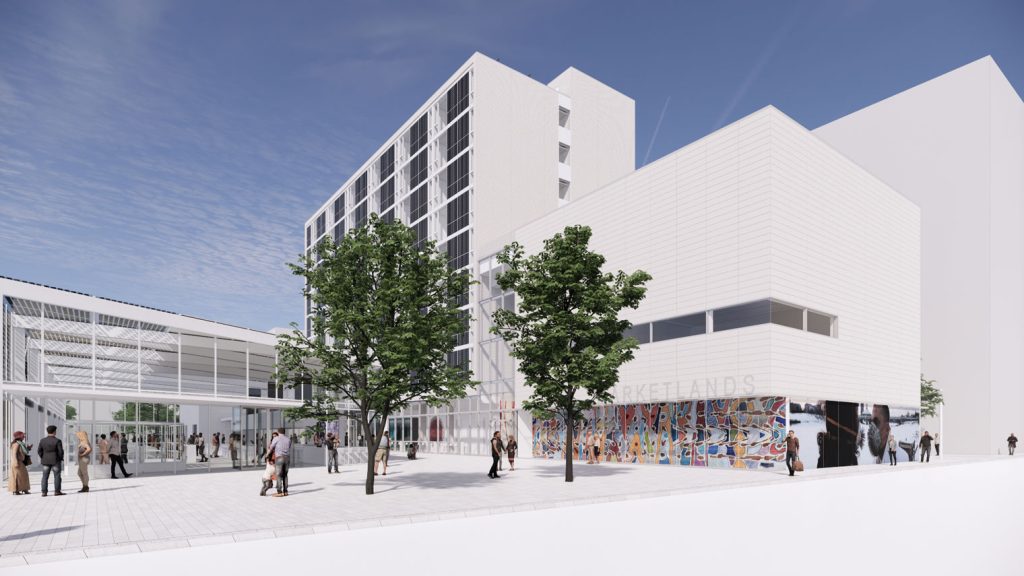
That residential-first mindset, according to Squires, will not only help to reduce dependency on the 9-to-5 work crowd, but it will also fundamentally change the perception of downtown Winnipeg. Thanks in part to the renewed mandate, there are already 4,000 new downtown homes expected in the next decade, which will eventually contribute to a downtown population of nearly 25,000. Squires cited the Market Lands Development—the $54 million mixed-use project being developed as a partnership between UWCRC 2.0 and CentreVenture— as a key part of the City’s renewal strategy.
“But we’re not stopping there,” said Squires. “Our strategic plan sets a bold target: 40,000 residents living in the downtown by 2050. Why? Because when people live downtown, everything follows. Retail follows rooftops, safety follows activity, and vibrancy follows density. People create a place.”
Our strategic plan sets a bold target: 40,000 residents living in the downtown by 2050.
Rochelle Squires,
President & CEO of CentreVenture Development Corporation
Indeed, CentreVenture’s newly unveiled strategic plan calls for ‘residential densification to support a 24-7 downtown community’, intended to mitigate the effects of office towers emptying out at the close of business. A growing residential base will— in time—warrant more grocery, pharmacy, fitness, retail and restaurant options, all of which can thrive in a well-populated core.
Moreover, with safety being a top concern for residents, downtown visitors, office tenants and property managers, it’s widely recognized that a vibrant downtown core discourages the conditions that thrive in emptiness. More residents mean more eyes on the street, more legitimate activity, and fewer dark pockets between business hours.
Squires maintains that achieving critical mass downtown will require the city to face some harsh truths in order to identify new opportunities. One statistic in particular, stands out: “We have more surface parking lots in our downtown on a per capita basis than any other Canadian city,” she said.
“I’m not saying we need to develop on every one of those parcels, but we certainly can use a little bit more development on some of these under-utilized lots.”
Unlocking Potential and Reclaiming Heritage Assets
CentreVenture’s ambitious plan to double the downtown population is built around five clear goals, with the first two focused on improving policies, reducing barriers, and strengthening partnerships.
The organization projects that reducing obstacles to development, and providing stronger financial incentives will drive more investment and contribute significantly to housing starts, including commercial-to-residential conversion opportunities where feasible.
“For every dollar that we invest in incentives, the return on investment is profound,” said Squires. “The downtown has 1% of the city land area, and yet 6% of its tax base. Over the last 25 years, we’ve been able to increase the tax base of the downtown by over 20% on just our CentreVenture projects alone. So that was a really good return on investment with public dollars.”
The plan’s third goal—titled ‘Activate downtown through focused development’—is about bringing priority projects to fruition, which includes transforming Graham Avenue “into a signature pedestrian street,” says Squires.
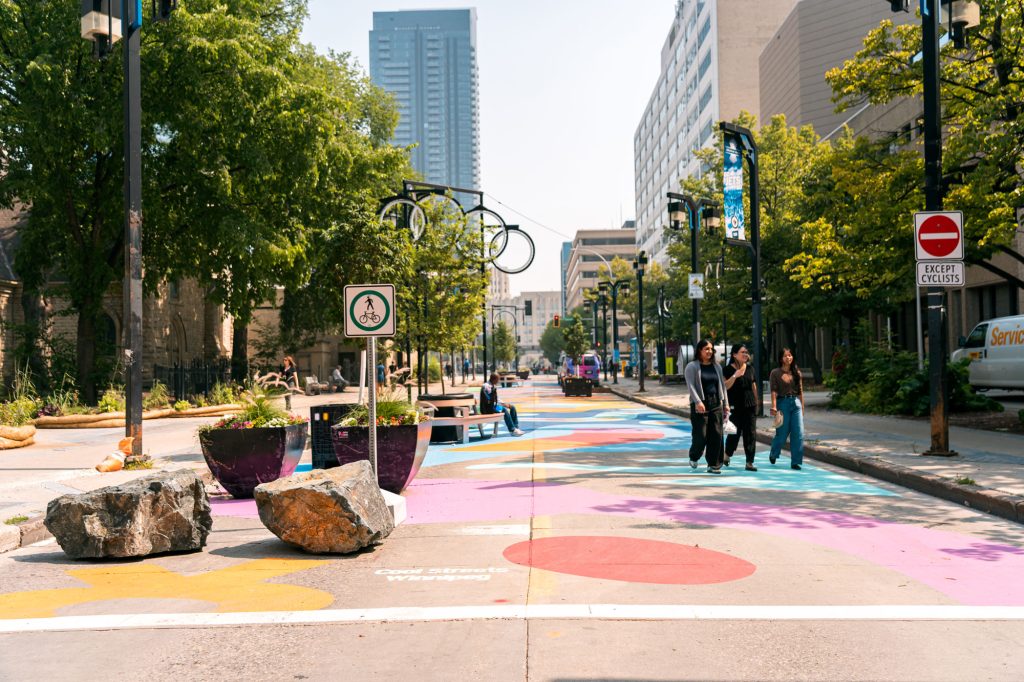
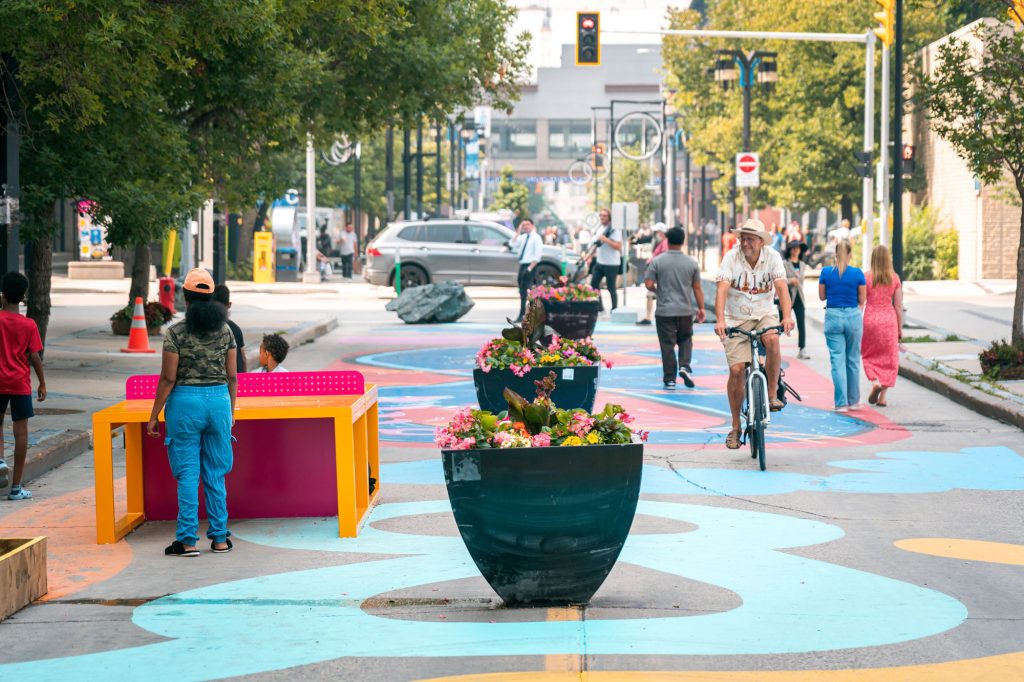
The streetscape work completed to date on Graham Avenue offers a preview of what’s to come. Once dominated by buses and traffic, the corridor is now being repositioned as “a street that invites people to stay, connect,
and return,” according to Squires.
Last June, floral planters, circular light structures, trees, boulders, benches, public art installations, and picnic tables were added along the corridor. Throughout the summer and early fall, the street became a popular gathering place for downtown workers, visitors, and residents alike.
Residential density is critical to any city and a key to the revitalization of our own downtown relies in part on adding more places for people to live.
Jim Moore, General Manager,
Portage Place, True North Real Estate Development
A number of Winnipeg’s heritage buildings are also identified as ‘priority projects’ per CentreVenture, and the organization is acutely aware of both the opportunities and the challenges. “Heritage buildings are historians’ dreams,” acknowledged Squires, but without a clear-eyed understanding of costs and age-related hurdles, they can turn into “developers’ nightmares.”
“A heritage building window is probably four times the cost of one for a non-heritage building,” said Squires. Adding window and door restoration to potential structural reinforcement work, masonry restoration, and façade preservation can quickly raise the cost per square foot beyond that of new construction.
Winnipeg boasts one of the largest historic districts in Western Canada, with the Exchange District featuring more than 100 turn-of-the-century buildings. As Squires notes, between 10 and 15 percent of those buildings are vacant—representing a tremendous opportunity.
“This is where we can really create a lot of density in our downtown, by restoring those vacant heritage buildings,” said Squires. She points to four projects in particular: St. Charles Hotel, Maw’s Garage (291 Bannatyne Avenue), 290 Garry Street, and 179 McDermot Avenue.
In January, CentreVenture announced that all four buildings will be converted to residential housing, with the help of $4.6 million in funding support. The 113-year-old St. Charles Hotel will be replaced with an 11-storey, 140-unit building, with significant work planned to preserve the heritage exterior. 291 Bannatyne will soon be home to a 114 unit building that will “bring immediate vibrancy to the Exchange District,” says Squires.
290 Garry Street will be renovated to allow for an additional 29 units, and 179 McDermot, built in 1903, will be another office-to-residential conversion, which will add 14 units.
“These projects are proof of what happens when public support meets private sector confidence,” Squires said.
All four projects certainly align with goals four and five of CentreVenture’s strategic plan: building up the organization’s internal capacity and profile, and promoting a dynamic, inclusive, and reconciled downtown.
That fifth goal, according to Squires, “means embedding values into our development approach, advancing reconciliation and ensuring downtown is safe and welcoming for everyone. Downtown is not just ‘geography’. It is the heart of our city.”
More Major Projects Underway
 Several additional downtown projects are currently being undertaken by BOMA member firms, each of them contributing to the broader vision for downtown that CentreVenture has championed.
One example is the redevelopment of Portage Place by True North Real Estate, which will transform the property into a major mixed-use complex, with housing, health services, retail, and public space. The goal is to position a long-underperforming asset into a functioning neighbourhood anchor.
“Residential density is critical to any city and a key to the revitalization of our own downtown relies in part on adding more places for people to live,” says Jim Moore, General Manager, Portage Place, True North Real Estate Development. “The inclusion of more than 200 residential units on the west pad of the Portage Place redevelopment is an extraordinary compliment to the housing component being developed by the Southern Chiefs Organization at the Wehwehneh Bahgahkinahgohn project”
These aren’t just construction projects. They are statements of belief in downtown Winnipeg. Housing is central to that belief.
Rochelle Squires,
President & CEO of CentreVenture Development Corporation
Added together, Moore noted, the two projects will introduce 580 new apartments to downtown, making it “alive with the energy that hundreds of new residents bring to a neighbourhood.”
Wehwehneh Bahgahkinahgohn, the former Hudson’s Bay building, is being converted into housing and community space under the leadership of Southern Chiefs’ Organization. The redevelopment of the heritage building, situated at the corner of Portage and Memorial Boulevard and spanning more than 650,000 square feet, will blend heritage preservation with large-scale residential use in the heart of downtown.
The Railside at The Forks development will turn surface parking lots into ten mid-rise buildings, supported in part by private investment and funding from all three levels of government. Railside will introduce a mix of condominiums, market-rate rentals and affordable housing to one of downtown’s most active districts.
“Railside will bring more daily life downtown by adding new homes at The Forks, building on existing movement, public spaces, and infrastructure,” says Sara Stasiuk, President and Chief Executive Officer of The Forks. “It reflects the same long term thinking that guides efforts across downtown, including CentreVenture’s focus on a diverse mix of residents and businesses.”
Approximately 350 residential units are expected to come online within the next two years, with the long-term goal of 1,200 units at the site by 2040.
According to Squires, the slew of major projects underway is evidence that the city is entering a new era. “These aren’t just construction projects. They are statements of belief in downtown Winnipeg. Housing is central to that belief.”
“With strong partnerships, shared leadership, and a commitment to possibility, I’m confident that the best chapter of downtown Winnipeg is still ahead.”